
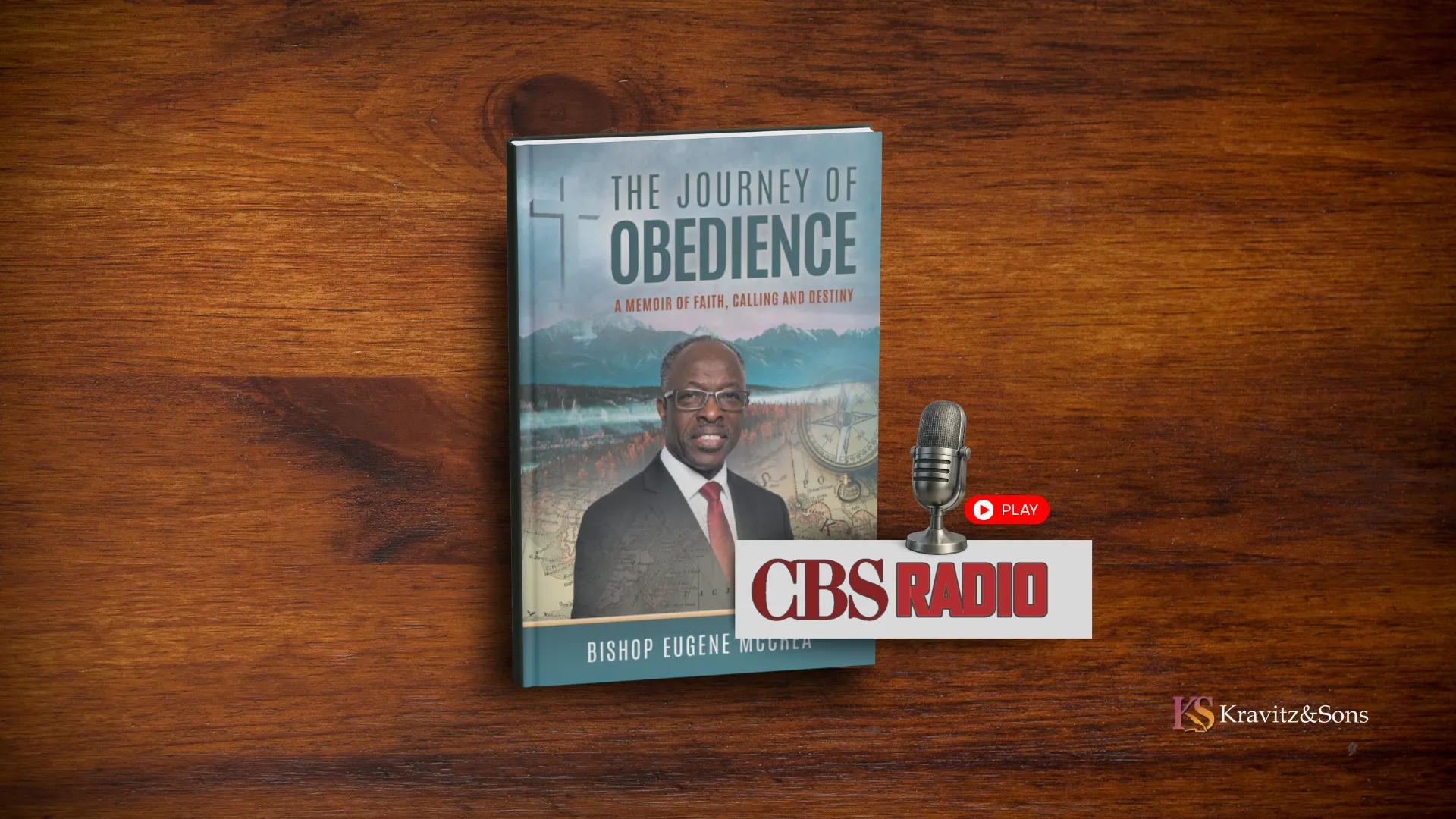
Meet Benjie Cole and People of Distinction
Benji Cole is the host of the internationally syndicated talk show People of Distinction, a platform built around conversations with what he describes as some of the most dynamic, intelligent, and successful people in the world. In this interview, Cole brings listeners into a conversation with Bishop Eugene McCrea about his memoir, The Journey of Obedience: A Memoir of Faith, Calling and Destiny, giving the audience a chance to hear the story directly from the man who lived it.
Cole also carries a family connection to broadcasting. He introduces himself as the son of Al Cole from CBS Radio and continues that broadcasting legacy through his own work. During the interview, he explains that People of Distinction is internationally syndicated and available through major distributors, with the continued support of its listeners helping the program share conversations with people from different backgrounds and fields.
The platform gives authors like Bishop McCrea an opportunity to go beyond simply talking about a book. Cole digs into the experiences behind the pages, asking about McCrea’s calling, his decision to move his family to Alaska on faith, the challenges he faced along the way, and the lessons he hopes readers will carry with them. The conversation becomes less about promoting a memoir and more about understanding the life that shaped it.
The Story Behind the Obedience
For Bishop Eugene McCrea, writing The Journey of Obedience was deeply connected to preserving his family’s story and sharing what he had learned throughout his life. During the interview, he explains that he was the youngest of thirteen children and that his parents were already older when he was born. Although he loved and respected his parents deeply, he realized that there was very little written history he could pass down to his own children and grandchildren. He wanted to create a record that would allow future generations to know what his parents had done and, at the same time, understand the journey God had taken him through.
That desire eventually expanded beyond his family. McCrea explains that he wanted people to hear his story directly from him rather than allowing others to interpret his experiences. His journey includes ministry, family, major relocations, uncertainty, illness, and international service, but the thread connecting these experiences is obedience. As he describes it, he was not chasing something for himself. He was responding to what he believed God was asking him to do. The memoir became a way of documenting that process and showing how faith can continue even when the next step is unclear.
Inside The Journey of Obedience
For Bishop Eugene McCrea, writing The Journey of Obedience was deeply connected to preserving his family’s story and sharing what he had learned throughout his life. During the interview, he explains that he was the youngest of thirteen children and that his parents were already older when he was born. Although he loved and respected his parents deeply, he realized that there was very little written history he could pass down to his own children and grandchildren. He wanted to create a record that would allow future generations to know what his parents had done and, at the same time, understand the journey God had taken him through.
That desire eventually expanded beyond his family. McCrea explains that he wanted people to hear his story directly from him rather than allowing others to interpret his experiences. His journey includes ministry, family, major relocations, uncertainty, illness, and international service, but the thread connecting these experiences is obedience. As he describes it, he was not chasing something for himself. He was responding to what he believed God was asking him to do. The memoir became a way of documenting that process and showing how faith can continue even when the next step is unclear.
Meet Bishop Eugene McCrea
Bishop Eugene McCrea is a pastor, teacher, author, and international servant of Jesus Christ. According to the biography included in the book, he is the founder and senior pastor of Praise Temple Way of the Cross Church of Christ International in Anchorage, Alaska, where he has served for more than three decades. He also serves on the Executive Board of Bishops for the Way of the Cross Church of Christ International.
McCrea’s path toward ministry began when he was around thirteen years old. In the memoir, he recalls being invited to church by his brother-in-law, Bishop Joe T. Gamble, with the simple question of whether he wanted to attend church and play the bass guitar. That invitation became a turning point. He repented, was baptized in the name of Jesus Christ, received the gift of the Holy Ghost, and began to recognize a deeper calling to serve and eventually lead.
His ministry later took him from South Carolina to Columbia, Washington, D.C., and finally Anchorage, Alaska. After arriving in Alaska in 1994, he became the pastor of Praise Temple. His ministry eventually expanded beyond the United States, with the book noting work across India, Africa, Haiti, Pakistan, and other locations. His international ministry has included training pastors, strengthening churches, and supporting humanitarian efforts in underserved communities.
What Readers Can Take From His Journey
One of the strongest ideas running through The Journey of Obedience is that a person does not always receive the complete map before taking the next step. McCrea’s move to Alaska is a major example. He and his family left Washington, D.C., without a clear financial plan or certainty about what awaited them. In the interview, he explains that the move placed enormous responsibility on him because his wife and six children depended on the decision he was making. Yet he believed he had received a direction he needed to follow.
The memoir develops that idea through the different seasons of McCrea’s life. His early academic struggles eventually led him toward masonry, where he found greater confidence and success. His years serving under different pastors became preparation for leadership. His seven years in Washington became a period of positioning before Alaska. Even the difficult seasons, including his battle with cancer, became part of the story he now uses to explain his understanding of faith and obedience. The book does not present the journey as effortless. Instead, it repeatedly returns to the idea that uncertainty, sacrifice, and responsibility can exist alongside faith.
Another important lesson is the connection between obedience and legacy. McCrea explains during the interview that he wanted to leave behind a written record because a person’s life can become part of what future generations inherit. That theme becomes even clearer toward the end of the book, where he writes about raising leaders, equipping others, and creating something that can continue beyond his own lifetime. The memoir ultimately moves from one man’s personal experiences toward a broader reflection on what happens when a life is lived with the intention of helping others.
For readers interested in faith, personal testimony, ministry, or stories about following a calling through uncertain circumstances, McCrea’s memoir offers a firsthand account of those experiences. His story moves from a childhood in South Carolina to ministry in Alaska and eventually to international work, while keeping obedience at the center of the narrative. As the closing reflection of the book puts it, the journey does not require understanding everything in advance. It focuses instead on taking the next step.
Accusing the American Judicial System of Rampant Corruption
A bold and chaotic love story that breaks every rule
Step into the madness and see how far love can really go.