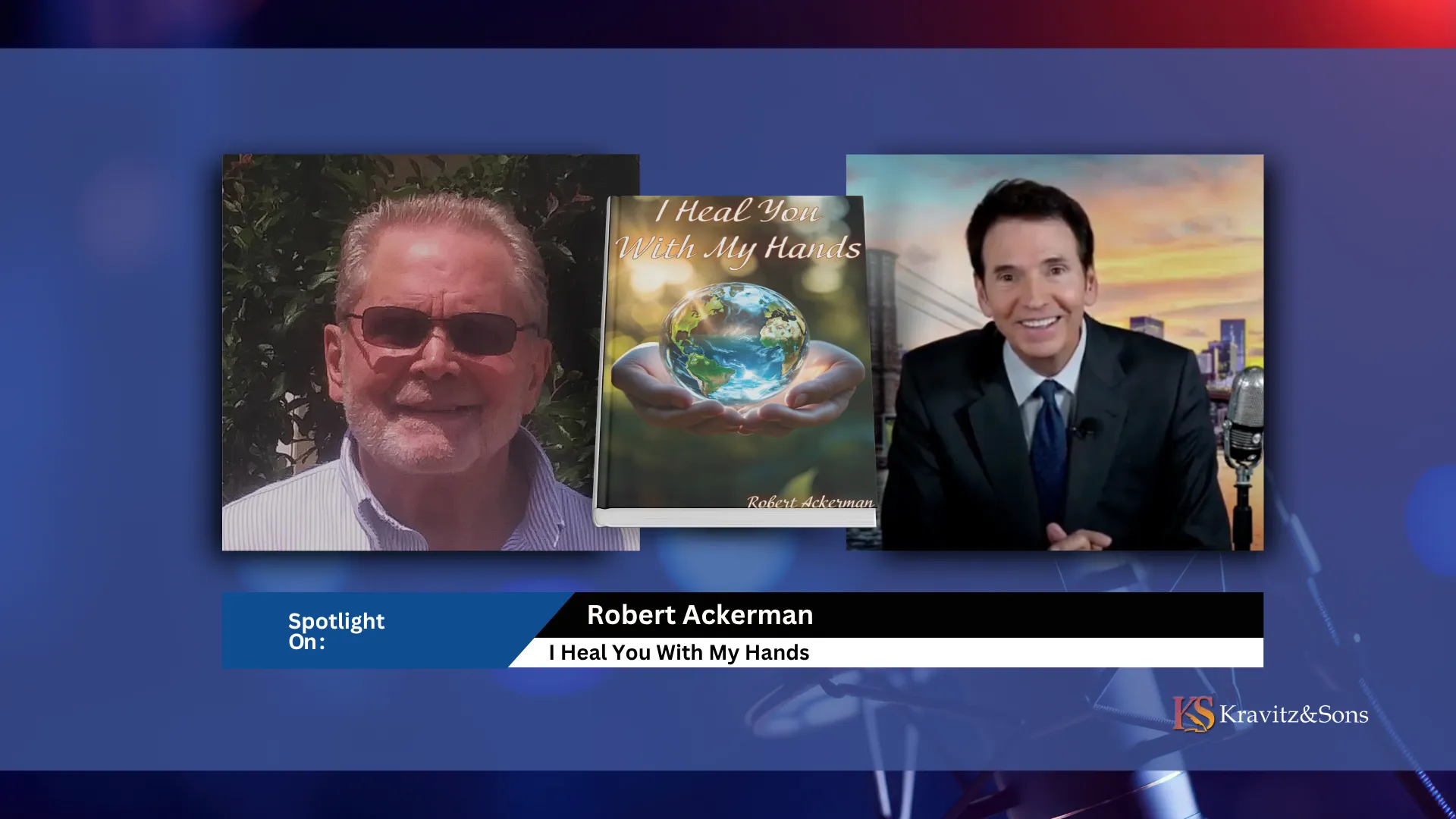
Meet Logan Crawford and the Spotlight Behind the Interview
Logan Crawford is the host of Spotlight with Logan Crawford, a program that brings attention to emerging authors and creators. During the interview, Crawford describes the show as part of the Spotlight Network and notes that it works with television and film legends while also giving authors and creators an opportunity to share their stories with a wider audience. The program is presented across Roku, Apple TV, and Amazon Fire TV, giving its featured guests a platform beyond traditional interviews.
As host, Crawford takes a direct but conversational approach to his discussion with Robert J. Ackerman. Rather than focusing only on the book itself, he asks Ackerman about the experiences behind it, including his military service, personal struggles, spiritual encounters, and changing understanding of God. This allows the interview to explore the life that shaped I Heal You With My Hands rather than treating the book as an isolated work.
Crawford also guides the conversation toward some of the most unusual and personal parts of Ackerman’s story. He asks about the author’s out-of-body experience at seventeen, his experience during the Vietnam War, his views on spirituality, and the meaning behind the book’s title. The result is an interview centered on the experiences, questions, and beliefs that Ackerman says eventually led him to write his story.
The Experiences That Inspired I Heal You With My Hands
For Robert J. Ackerman, the inspiration behind I Heal You With My Hands is closely connected to a spiritual experience he says occurred in 1969 while he was in Thailand. During the interview, Ackerman recalls an experience in which he believed God took the breath from his body and then returned it. He says that afterward he received the message that someday he would “heal with your hands.” That statement remained with him for decades as he tried to understand what it meant and how it connected to his life.
The book grew from that search for understanding. Ackerman connects the message to experiences throughout his life, including an out-of-body experience when he was seventeen, his service in the Air Force during Vietnam, struggles with addiction and emotional hardship, meditation, prayer, and other spiritual experiences. The interview also reveals that his writing goes beyond personal memoir. Ackerman uses his experiences to explore God, reincarnation, consciousness, Jesus, the Bible, human connection, and the relationship between spirituality and the physical world. His own introduction describes the book as a true account of an “interesting life” and explains that he hopes readers may learn something from his experiences.
A Life Story That Moves From War to Faith and Bigger Questions
I Heal You With My Hands follows Robert Ackerman through many stages of his life, beginning with his childhood and continuing through his experiences as a young man, his military service, personal relationships, struggles with alcohol, health challenges, spiritual experiences, and later reflections on religion and humanity. The book’s contents show just how broad the story becomes, with sections covering his youth, an out-of-body experience, Vietnam, mental health, Bethlehem Cave, drug use, reincarnation, Bible inconsistencies, Jesus, oneness, climate change, plastic pollution, overpopulation, and the sixth great extinction event.
The Vietnam chapters form an important part of Ackerman’s personal history. His account describes his work with C-130 aircraft, missions over Vietnam, dangerous flights, and moments when aircraft and crew members came under fire. In one incident described in the book, Ackerman helped treat an injured co-pilot after their aircraft was hit, while the damaged plane struggled to return safely to base. These experiences are placed alongside his spiritual questions, creating a memoir that moves between personal history and his attempts to understand God, life, death, and humanity’s place in the universe.
A Life of Service, Struggle, and Discovery
Robert J. Ackerman presents himself in the book as someone whose life has included both difficult personal experiences and years of service to his community. According to the biography included in the book, he served as Director of the Pennington County Drug and Alcohol Task Force and Director of the Meade Street Halfway House. He also served as Director of the Western South Dakota Referees Association, Director of Keystone Ambulance Service, and Director of the West Dakota Water Development Association. He volunteered as a Rockerville firefighter for seven years, coached a soccer team that won the South Dakota State Soccer Tournament, volunteered at the Salvation Army, and spent three decades researching climate change.
His personal story is equally important to understanding the book. Ackerman describes growing up in Rapid City, South Dakota, his experiences in Catholic school, his family life, his early encounters with alcohol, his years in the Air Force, and his experiences in Vietnam. The book also discusses his struggles with addiction, PTSD, depression, anxiety, health problems, and memory loss. In his prologue, Ackerman explains that these experiences became part of his reason for telling his story and connecting his life experiences to his spiritual beliefs.
A Memoir That Asks Readers to Question and Explore
I Heal You With My Hands is a book built around questions as much as answers. Through his experiences, Ackerman asks readers to consider how difficult events can influence a person’s understanding of faith, how spiritual experiences can change someone’s outlook, and how ideas about God can evolve over an entire lifetime. His story also explores the relationship between the physical body and the soul, particularly through the out-of-body experience he describes at seventeen. In the book, he says the experience led him to believe that people are souls living in physical bodies.
The book also expands beyond autobiography. Ackerman connects his spiritual beliefs with subjects including reincarnation, consciousness, religion, science, environmental concerns, climate change, overpopulation, plastic pollution, and the sixth great extinction event. His discussion with Logan Crawford reflects that wide scope, moving from Vietnam and personal struggles to questions about God, spirituality, healing, and the meaning of human existence.
For readers, one of the defining features of the book is that Ackerman does not present a simple, conventional memoir. Instead, he uses his life as the starting point for a much larger discussion about what he believes, what he has experienced, and what he thinks those experiences mean. His story may particularly interest readers who enjoy memoirs that combine personal history with spirituality, religion, unusual experiences, and broader questions about humanity and the future.
The conversation with Logan Crawford provides an accessible introduction to those ideas. Ackerman’s experiences, from military service and personal hardship to his spiritual encounters and lifelong search for meaning, give the interview and the book a common thread: a man looking back on an unusually eventful life and trying to understand what those experiences have taught him.