

When Numbers Start Making Patterns
Numbers can look completely ordinary until you put them together in the right way. Suddenly, patterns begin to appear, rows and columns connect, and something that seems impossible starts to make sense. The Methods, Marvels, and Madness of Magic Squares by Ronald J. Wendel takes readers into that fascinating world, exploring how magic squares are created, changed, studied, and transformed into countless different arrangements.
Magic squares have been around for at least a thousand years, attracting the attention of mathematicians, scientists, and curious minds who enjoy finding order in numbers. What makes this book different is that it does not simply show readers a few magic squares and leave it there. Ronald J. Wendel explores the methods, relationships, patterns, and symmetries behind them. There is plenty to discover, whether you already enjoy mathematics or you are simply the kind of person who likes figuring out how things work.
"A magic square is a square array of numbers where the rows, columns and diagonals all add up to the same number."
More Than Just Adding Numbers
The basic idea behind a magic square may sound simple, but the deeper you look, the more interesting it becomes. The book explains that creating a magic square involves an initial setup and a method or algorithm that transforms that setup into the finished square. Readers are introduced to different approaches for constructing magic squares of various orders, including odd, singly-even, doubly-even, prime, and composite orders.
The book also shows that a finished magic square does not have to remain exactly as it was first created. Rows and columns can be swapped, squares can be rotated or mirrored, and other operations can produce new arrangements. Some changes create squares that are similar to the original, while others create a completely different and unique magic square. This gives the subject another layer that makes it feel less like memorizing formulas and more like experimenting with a mathematical puzzle.
One of the biggest things readers can take from the book is an appreciation for patterns. Magic squares demonstrate how numbers can have relationships that are not immediately obvious. Later sections even explore connecting numbers with lines to reveal shapes and patterns hidden inside the squares. The further readers go, the clearer it becomes that there is much more happening inside these grids than simple addition.
The Engineer Behind the Squares
Ronald J. Wendel graduated from college with an engineering degree and worked throughout his career as both an engineer and a software developer. His interest in magic squares eventually led him to create software capable of generating and manipulating them, giving him a practical way to explore the mathematical patterns that interested him.
That combination of engineering, software development, and curiosity is reflected in the book itself. Rather than approaching magic squares from only one direction, Wendel examines them through methods, construction techniques, transformations, and visual patterns. His approach gives readers an opportunity to see how mathematical curiosity can grow into a much deeper exploration of a subject.
Step Into the Magic Square
If you enjoy mathematics, puzzles, patterns, or simply figuring out why something works, The Methods, Marvels, and Madness of Magic Squares by Ronald J. Wendel gives you plenty to explore. It is a book that turns a simple grid of numbers into a much bigger world of possibilities.
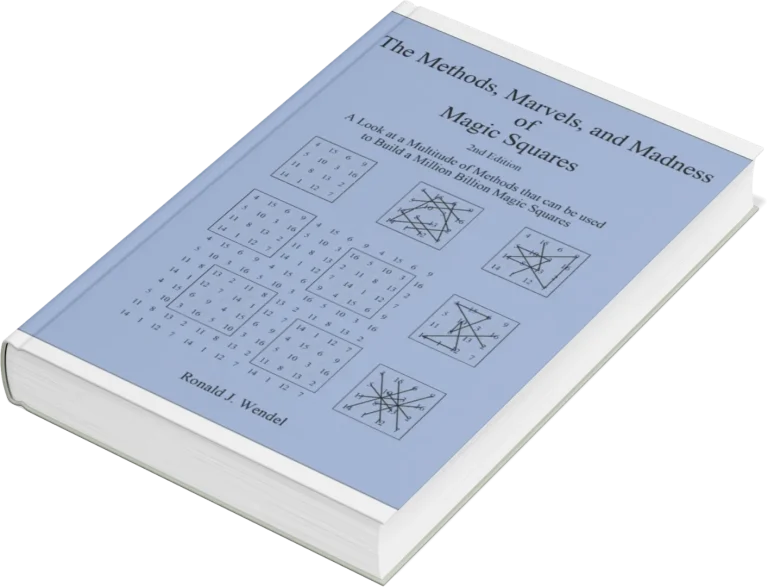
The Methods, Marvels, and Madness of Magic Squares
A Look at a Multitude of Methods That Can Build a Million-Billion Magic Squares