
BookCon 2026 | STORIES THAT COME TO LIFE IN REAL TIME. WHERE FANS MEET THE MINDS BEHIND THE PAGES. A PLAYGROUND FOR READERS, CREATORS, AND IDEAS. PANELS. SIGNINGS. EXPERIENCES THAT FEEL PERSONAL. WHERE POP CULTURE AND LITERATURE COLLIDE. DISCOVERY, CONNECTION, AND NONSTOP ENERGY. A WEEKEND WHERE STORIES STEP OFF THE PAGE. THE SPACE WHERE READERS BECOME PART OF THE STORY.
BookCon emerged as a response to something readers had been wanting for years: a space where they could engage directly with the stories and the people behind them. Evolving from the industry-focused BookExpo, BookCon opened the doors to a wider audience, transforming into a reader-driven event that celebrates not just books, but the experience of storytelling itself. Over time, it has grown into a major gathering where fans, authors, and creators come together in one shared space.
Unlike traditional book fairs, BookCon thrives on interaction. It’s a place where readers don’t just browse, they participate. Panels, live interviews, book signings, and fan-driven discussions fill the event with energy. It creates an environment where stories are not only read but talked about, questioned, and experienced in real time.
The 2026 edition continues to highlight the evolving relationship between readers and storytelling. It reflects a world where audiences are more engaged than ever, shaping conversations, trends, and the way stories are shared. BookCon stands as a space where creativity meets community, and where every voice has the chance to be heard.
Exhibitors from across the publishing world take part, including major publishers, independent authors, media platforms, and creative brands. The event floor becomes a hub of discovery, where new ideas are introduced, connections are built, and stories find their audience.
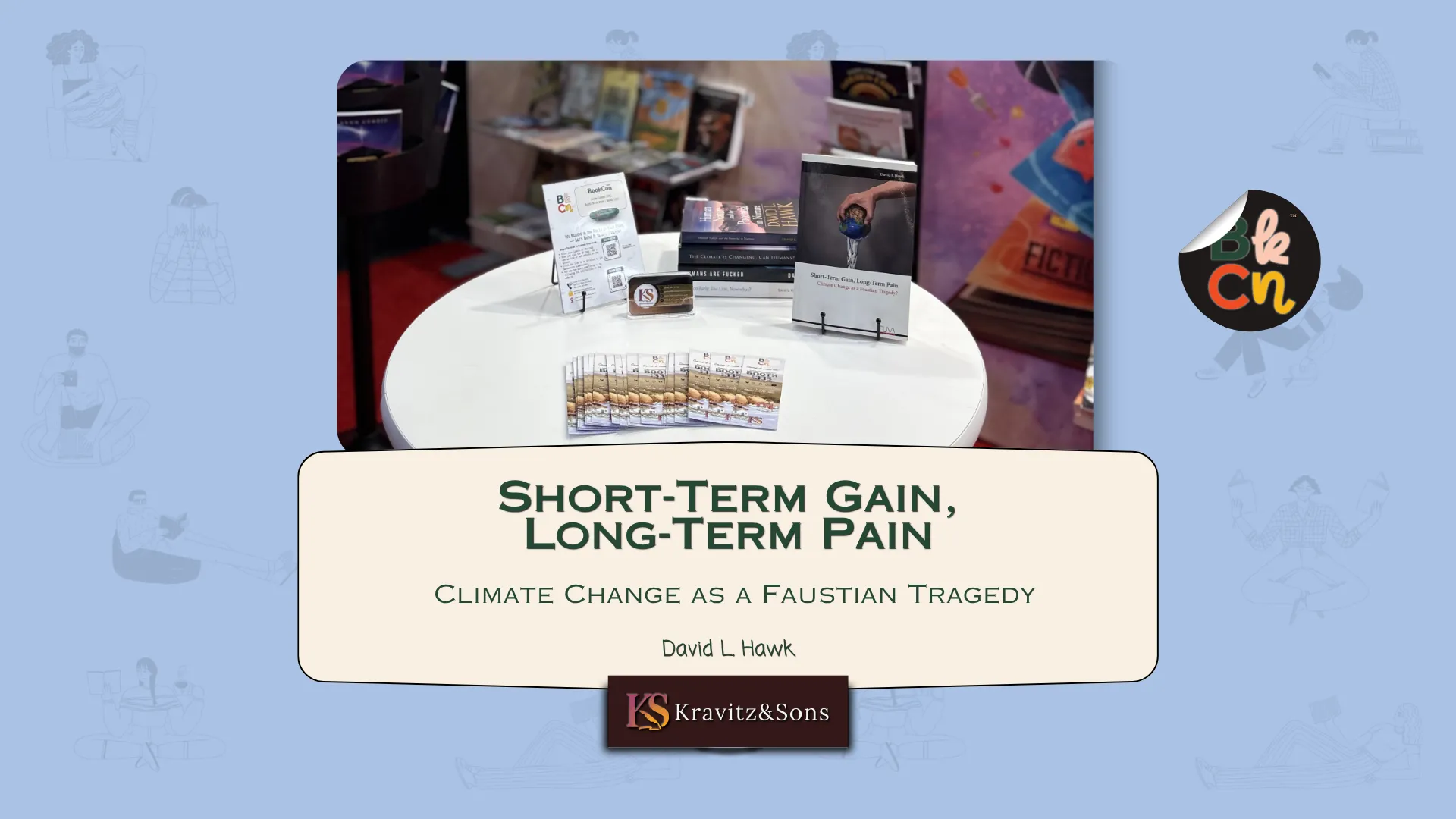
Amid this high-energy and interactive setting, Kravitz and Sons is proud to join BookCon 2026. We’re excited to exhibit Short-Term Gain, Long-Term Pain: Climate Change as a Faustian Tragedy by David L. Hawk, a reflective and thought-provoking work that looks at climate change through a deeply human lens. It goes beyond science and data, focusing instead on how everyday choices, convenience, and modern systems slowly shape the world we live in.
This book feels personal in a way that sneaks up on you. It connects global issues to simple moments, like navigating a city or relying on technology, showing how the artificial world we’ve built often pulls us away from the natural one. In a space driven by discovery and honest conversation, it offers a perspective that feels both familiar and uncomfortable, asking readers to look at their role in a much bigger picture.
A Perspective Built Across Worlds
David L. Hawk brings a wide and layered background into his writing. His journey moves through architecture, city planning, and systems science, supported by advanced studies and decades of research. That range gives him the ability to see connections that are not always obvious at first glance.
His work spans countries, disciplines, and real-world systems, from academic research to global initiatives. That experience shows in how he writes. His style is reflective, almost observational, allowing ideas to build naturally rather than forcing conclusions. It feels like he is walking readers through a thought process rather than telling them what to believe.
A Reflection on Choices and Consequences
Short-Term Gain, Long-Term Pain uses everyday situations to explore something much bigger. It starts with simple moments, like trying to find your way in a city or relying on technology for direction, and slowly expands into a broader reflection on how modern life has distanced people from nature.
There are no traditional characters, but the role of the reader becomes central. You move through different settings, from global cities to quiet natural spaces, experiencing the contrast between what is real and what is constructed. The book builds on this contrast, showing how convenience and efficiency often come at a hidden cost.
The core idea is clear but powerful. Human systems are designed for immediate results, often ignoring long-term consequences. This pattern repeats across industries, technologies, and lifestyles, leading to environmental damage that feels gradual but is deeply rooted. The lesson sits quietly underneath it all. What feels small today can shape something much bigger tomorrow.
A Question That Stays With You
This is not a book that rushes to give answers. It leaves you with a question that lingers, asking you to look at your own habits and the world around you in a different way.
asdasdasdasdasda
asdas
asdas
Short-Term Gain, Long-Term Pain
Climate Change as a Faustian Tragedy
Take a moment and ask yourself where all of this is leading