
LOS ANGELES TIMES FESTIVAL OF BOOKS | THE LARGEST LITERARY GATHERING IN THE COUNTRY. WHERE 500+ VOICES SHARE ONE STAGE. STORIES, CELEBRITIES, AND CONVERSATIONS IN ONE PLACE. A FREE FESTIVAL OPEN TO EVERY KIND OF READER. PANELS, SIGNINGS, AND IDEAS ACROSS AN ENTIRE CAMPUS. WHERE BOOK LOVERS AND STORYTELLERS COLLIDE. A WEEKEND BUILT ON DISCOVERY, COMMUNITY, AND CREATIVITY. WHERE STORIES DON’T JUST LIVE, THEY CONNECT PEOPLE.
When the Los Angeles Times Festival of Books first began in 1996, it was built on a simple but powerful idea: bring books, authors, and readers together in a way that feels open, accessible, and alive. What started as a local literary gathering quickly grew into one of the largest and most celebrated book festivals in the United States. Over the years, LATFOB has become a cultural landmark, where storytelling goes beyond pages and becomes part of a shared, public experience.
Each year, the University of Southern California transforms into a vibrant literary space filled with energy, creativity, and conversation. Walk through the festival and you’ll find author panels, live discussions, book signings, performances, and interactive exhibits happening all at once. It’s not just about selling books. It’s about connecting people through ideas, perspectives, and stories that matter.
The 2026 festival continues that tradition, bringing together a diverse range of voices across genres, backgrounds, and styles. From emerging writers to established authors, the event celebrates storytelling in all its forms. It reflects a literary world that is constantly evolving, shaped by new ideas, cultural shifts, and the voices that dare to be heard.
Thousands of exhibitors take part in the festival, representing publishers, independent presses, educational institutions, and creative communities. The entire space becomes a living network of storytelling, where discovery happens naturally and every corner offers something new to explore.
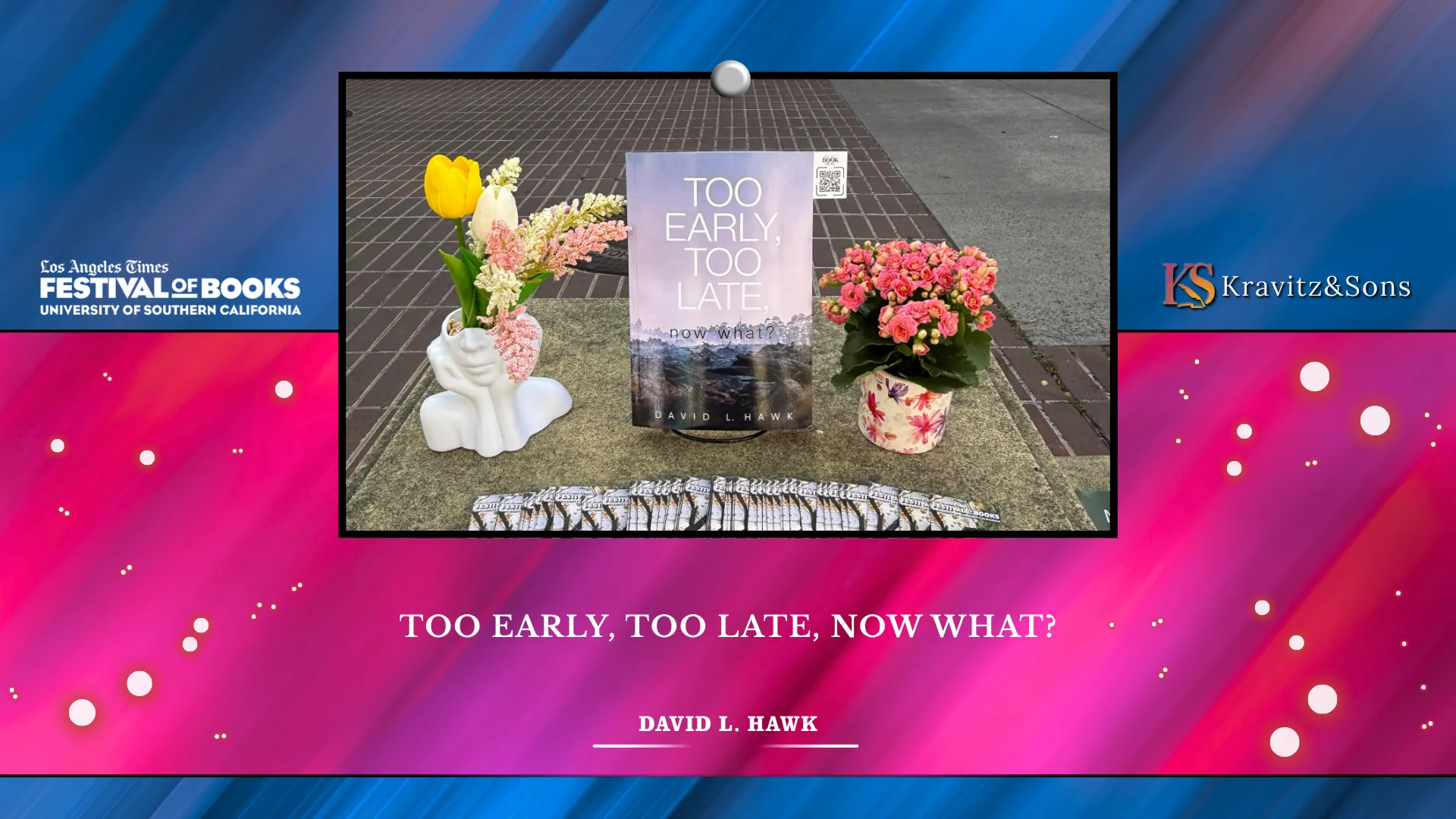
Amid this dynamic and welcoming environment, Kravitz and Sons is proud to be part of the Los Angeles Times Festival of Books 2026. We’re excited to exhibit Too Early, Too Late, Now What? by David L. Hawk, a reflective and intellectually grounded work that dives into systems thinking, research, and the complexity of environmental and social challenges. It invites readers to explore ideas that were once questioned, debated, and ultimately accepted for their depth and clarity.
This work carries its own voice, perspective, and purpose, offering readers something both meaningful and memorable. As it steps into a space built for connection and discovery, it stands ready to meet readers who are looking for ideas that challenge how they think.
A Researcher Who Questioned the Norm
David L. Hawk’s journey as a researcher shows in this work. His academic path through systems sciences and his involvement with institutions like the Wharton School shaped how he approaches complex problems.
This book reflects a time when his ideas were not immediately accepted. Reviewers challenged his work, asking for more depth, more skepticism, more complexity. Instead of backing away, he leaned into those challenges.
That process became part of the story itself. It shows how ideas evolve, how they are tested, and how they eventually find their place when given the space to grow.
A Deep Dive Into Systems and Complexity
The book centers around the idea of environmental deterioration and how systems play a role in shaping it. It is not just about the environment. It is about how human decisions, structures, and policies all connect.
The setting here is more academic, but the impact is real. Universities, research centers, and institutions become part of the story, showing how knowledge is built and refined over time.
The roles are played by thinkers, researchers, and decision-makers, all trying to understand problems that do not have simple solutions. That is what makes the book feel layered and thoughtful.
Understanding the Questions That Matter
What stands out in this book is the focus on questioning. Not just accepting ideas as they are, but digging deeper to see if they truly hold up.
The inclusion of earlier versions of the work shows honesty. It gives readers a chance to see the evolution of thought, not just the final polished version. That alone adds depth to the reading experience.
The lesson here is not about finding one answer. It is about learning how to approach complex problems with patience, curiosity, and a willingness to rethink what you believe.
A Book That Makes You Think Twice
This is not a light read, but it is a meaningful one. It challenges you to slow down and really think about the systems shaping the world around you.
If you enjoy exploring ideas that push beyond the surface, this book gives you that opportunity.
Too Early, Too Late, Now What?
Step into a deeper way of thinking and see what questions arise